
Team before self
Hockey coach Per Mårts says as one of his lessons:
"It's not teams I've coached,
it's about individuals, who need to meet where they are."
Personally, I think it wonderfully reflects the challenge of leading a team. The balance between getting the whole team to work together in a meaningful way, while at the same time each individual needs to develop and act from the level they are at. In this month's newsletter "Food for Thought", you will read more about different perspectives on how to lead and develop a team.
- How is your team building going?
- The importance of thinking both/and instead of either/or
- Meeting-free days - could this be an attraction?
- Teamflow as a unique brain state
- Podcast - Own your armour - in The Game of Teams
I hope you will find some inspiration in the attached articles.
How is team building going?
Those of you who follow me know that when we work on developing the management team, we work in parallel on developing the group as a team while working on a specific business issue. Rita McGrath is originally a strategy researcher. She studied business & strategy and has gradually realized the importance of capable teams. Her friend Amy Edmondson started at the other end and has moved from psychological safety in teams to how the group works on the mission.
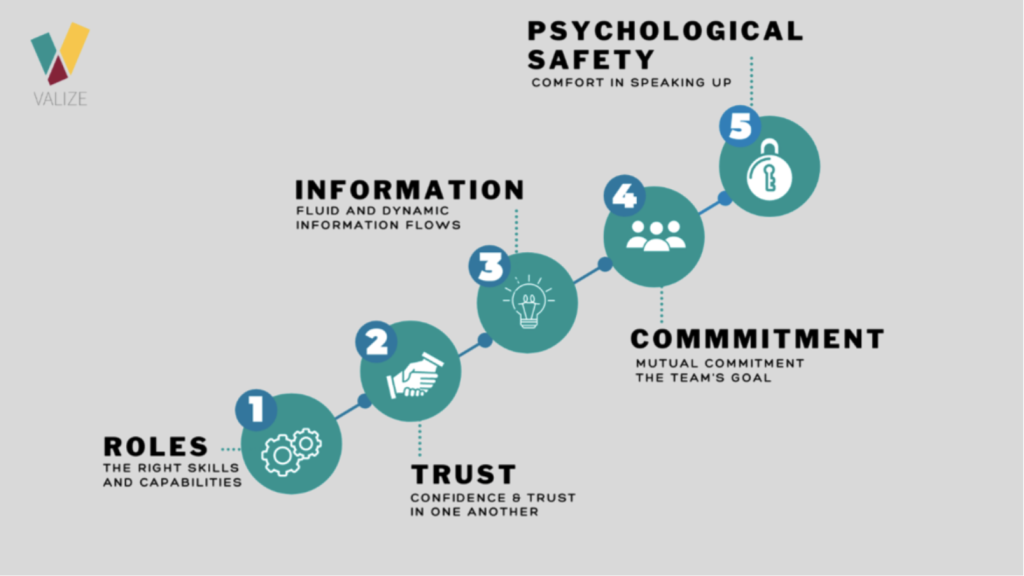
In this article, Rita summarizes her experience and presents a simple model that is very much in line with how I see the development of management teams.
The old models don't really apply anymore when we work remotely and agile.
She describes it as 'five core characteristics that determine whether a team is likely to produce results - or just frustration'.
Link to article:
"Unless you are a sole contributor, your success depends on other people"
(Jeff Pfeffer)
The importance of thinking both/and instead of either/or
Professor Wendy Smith has written an interesting book with the title; 'Both/And Thinking: Embracing Creative Tensions to Solve Your Toughest Problems'. In the book she talks about the importance of being able to handle paradoxes and think both/and. Here is an introductory text that briefly (4 min) describes her concept: Both/And Thinking, A New Way To Solve Your Toughest Problems & Transform Your Company
She makes an interesting distinction between dilemmas and paradoxes.
Here is a link to a longer (55 min) podcast where Wendy Smith has the opportunity to describe her thoughts and concepts about Both/And-thinking. "The Culture Lab - Wendy Smith - Both/And Thinking; Embracing Creative Tensions".
I think the book might be worth reading and it goes on my to-read list.
Meeting-free days - could this be an attraction?
By starting with meeting-free days, during which people work in their own rhythms and collaborate with others at a pace and on a schedule that is comfortable, not imposed. The results of this report are outstanding in terms of productivity and well-being.
Today's knowledge workers typically spend more than 85% of their time in meetings, which studies show negatively affects people psychological, psychical, and mental well-being.
When meetings were reduced by 40% (equivalent to two days per week), the researchers found that productivity became 71% higher as employees felt more empowered and independent.
Copyright MIT Sloan
Click here to access the article The surprising impact of meeting-free days
The article is available at MIT Sloan where you can access part of it without logging in. If you log in, you get free access to their entire article (you get 5 articles/month for free).
Perhaps one or two meeting-free days would be something to try next month and see for yourself if the researchers' findings are relevant to you and your organization!
Teamflow as a unique brain state
Team flow is experienced when team players get "in the zone" to accomplish a task together. Great teams experience this psychological phenomenon, from sports to music bands and even professional work teams. When teamwork reaches the team flow level, one can observe the team perform in harmony, breaking their performance limits.
Researchers have found certain brain waves and regions of the brain that are sensitive to flow compared to non-engaging teamwork or working solo.
have found the brain waves and regions sensitive to team flow compared to non-engaging teamwork or a solo flow.
This study is the world's first attempt to study this psychological state objectively. These neural correlates not only can be used to understand and predict the team flow experience. The authors are working on utilizing the findings to monitor and predict team performance.
This study is a first attempt to objectively study this psychological state. These neural connections can not only be used to understand and predict the experience of flow in the team. The authors are working on using the results to monitor and predict a team's performance. Breathtaking!
Link to Teamflow as a unique brain state in Neuroscience News
Podcast of the month - Own your armour - in The Game of Teams
This conversation explores the changes in mindset that we need to make to resolve interpersonal conflicts and the consequences of the negative group dynamics at work. Michelle Brody reminds us that when you think about conflict you go against biology. We need to understand the threats we perceive, the armor we put on and the impact that this protection has on others.
Success in the Management Team
I am currently prototyping my digital course "Success in the Management Team". I have asked some CEOs, HR managers and members of the management team to go through the structure and format. I got a lot of valuable feedback that will help me make the course even more relevant, rewarding and accessible.
After completing "Success in the Management Team":
- Do you know how to create a high-performing management team?
- Can you as a member add more value to your management team?
- Have you received specific tools that can directly increase your management team's ability to work together?
- Have you prepared yourself to lead a management team to success?
- Could you better lead and coach your own management team?
The course consists of short sections that you can learn at airports, waiting rooms or during your commute to work. You can just sit in the comfort of your office, or at home, and go through several sections that are of particular interest to you.
Each section ends with an opportunity for reflection. This gives you the opportunity to relate to your own situation in your management team.
The sections consist of a 5-10 minute videos. They are complemented by a summary text with key messages and the main image/model.
It works equally well on mobile, iPad and desktop.
One of the testers, an HR director, commented on the concept: "In combination with the development of the entire management team, "Success in the Management Team" can be extremely valuable for the individual, the management team and the entire company. I have not seen anything like this before."
Read, listen and reflect
I hope you will find some inspiration for your further development through these carefully selected contributions. I also hope that you take the time to reflect and think. That's when things can become clearer and solutions that you didn't know existed emerge. Take a walk without music or a podcast, sit in a comfortable chair with a notebook, go for a jog - the method of reflection is highly personal. The important thing is that we actually do it. Writing down our unsorted thoughts and feelings further contributes to future wisdom.
With this, I now press Send and wish you a rewarding experience,
Michael